Policy Toolkit: Family and Care in Theatre
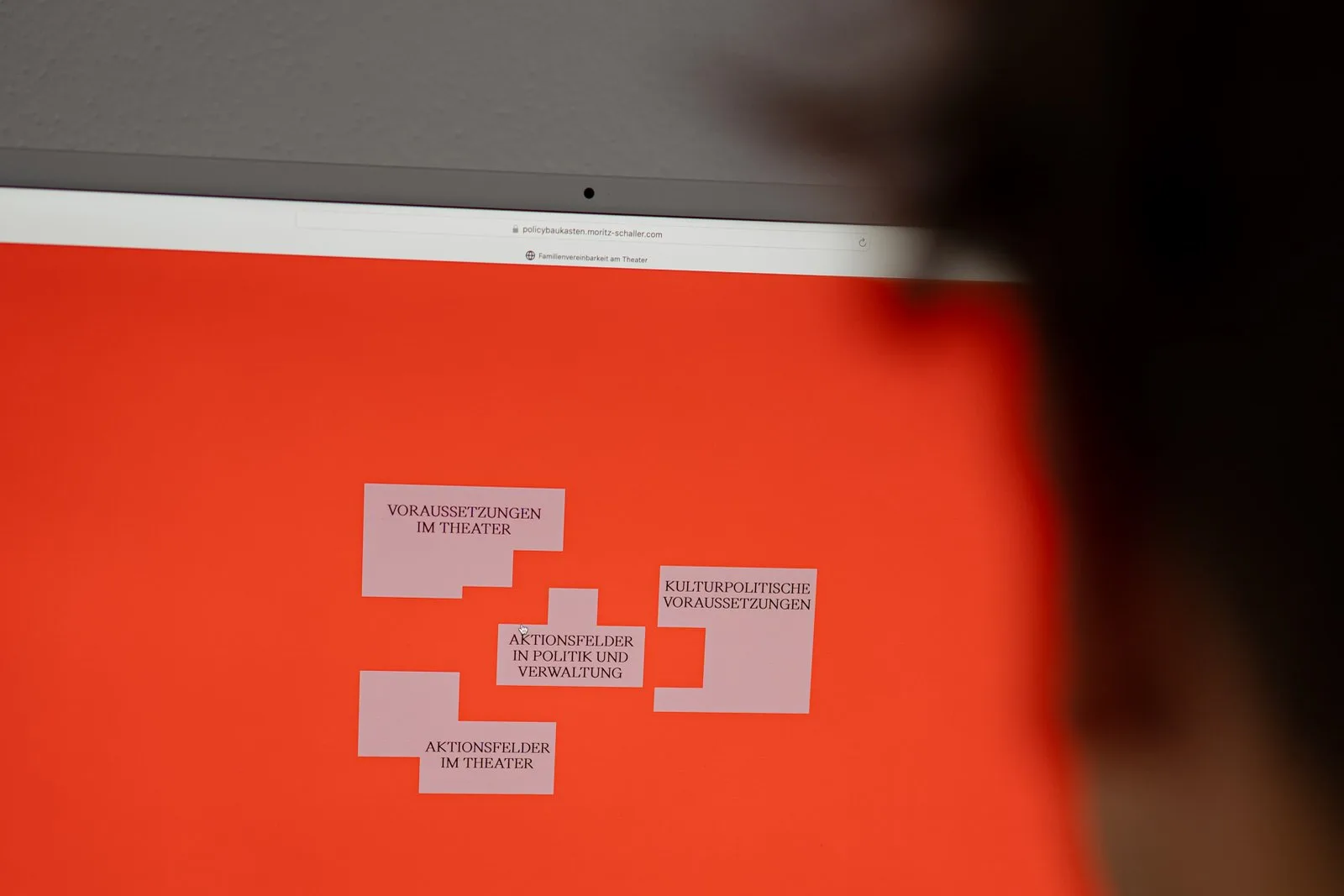
An interactive policy toolkit that frames family and care in theatre as a strategic design challenge. With 4 categories, 20 operators and 86 indicators, it provides an instrument for institutions to analyze their status quo, set priorities and structure transformation processes.
The Challenge
Theatre work is still structured around high availability, unpredictable schedules and intense demands in many institutions. For people with care responsibilities, this quickly becomes a structural exclusion problem. The debate was there — but it was often emotionalized, scattered across many individual perspectives and rarely prepared in a way that could lead to concrete cultural policy and organizational decisions. That was precisely the challenge: translating a complex, normatively charged topic into actionable cultural policy.
Our Approach
Our approach was not to produce yet another study, but to create a usable decision-making and transformation instrument. We worked with Frauke Meyer to translate the knowledge built up over years at the Frauenkulturbuero into a structure that mediates between theatre practice, research and cultural policy. A participatory approach was key: perspectives from theatres, associations, unions, initiatives and cultural policy were systematically gathered and shaped into a form that provides orientation without smoothing over the field's contradictions. This turned a barely manageable problem area into a workable policy field.
The Solution
The result is an interactive policy toolkit that frames family and care in theatre as a strategic design challenge. Instead of abstract demands, it offers a concrete architecture of 4 categories, 20 operators and 86 indicators. The toolkit connects bottom-up and top-down perspectives and addresses cultural policy, administration, theatre directors and artists alike. Our solution was not communication about a problem, but the development of a format that allows institutions to analyze their status quo, set priorities and structure transformation processes. This is how we rethink cultural policy: not as pure programmatic intent, but as translatable, applicable infrastructure for change.
Impact & Transfer
The toolkit gave the topic reach, connectivity and transfer potential. This is evident first in the public resonance: the Frauenkulturbuero rolled out the toolkit through an Instagram/Facebook campaign featuring voices from the arts and culture, including Kathrin Maedler (Theater Oberhausen), Jonas Zipf (Kampnagel), Claudia Schmitz (Deutscher Buehnenverein) and Anna Teuwen (Kampnagel). Second, the approach was carried forward in publications: alongside the Frauenkulturbuero's policy paper, a further publication titled "Good Working Conditions in Theatre — For Families Too?" was produced with the Friedrich-Ebert-Stiftung, explicitly building on the policy toolkit. Third, the project reached education and training: the toolkit was presented in the Theatre Management continuing education program at LMU Munich, where feedback indicated it was already being used in a thesis and recommended for workshops. Fourth, the toolkit was presented at the symposium "Parenting in the Arts" on July 3, 2025 at Kunstverein Munich. What started as a niche topic became an instrument that structures debates, inspires practice and enables cultural policy follow-up communication.